

A third (32%) of the British citizens would not report problems with fire door, with a perceived lack of personal repercussions being one of the main reasons for not reporting, finds a new research to mark the Fire Door Safety Week that ended in November 2022.
Organisers of the Fire Door Safety Week say the findings show that there is a “clear lack of accountability” over reporting fire door issues, and that lives are being put at risk as a result.
Despite three quarters (75%) correctly believing that propping a fire door open stops it performing its role in the event of a fire, 44% wouldn’t act over a propped open fire door as they wouldn’t know who to report it to, and almost half (49%) do not feel it’s their place or role to report it.
Helen Hewitt, CEO of the British Woodworking Federation which founded Fire Door Safety Week, said, “Individual action is crucial in preventing fire tragedies. Fire doors propped open put lives at risk in the unfortunate event of a fire. Without being properly closed, a fire door cannot hold back the spread of fire and smoke to fulfil its life-saving role.”
The research showed that propped open fire doors are a common occurrence, with 10% of respondents having seen a propped open fire door in their place of residence on some occasions and 20% in the workplace. It also identified that the two most common objects used to prop open a fire door are a wedge and a fire extingui sher.
Concerningly, 31% incorrectly believed that a fire door that was propped open with a wedge or a fire extinguisher was safe and 18% didn’t believe a propped open fire door poses a risk to those in the building so wouldn’t act. Not only was a propped open fire door incorrectly deemed as safe, but 15% believed that keeping a fire door closed stops it from performing, highlighting a lack of understanding around the role fire doors play in the event of a fire.
The fact is a fire door can only protect from fire and smoke if it is closed.
The research also found a lack of understanding over what constitutes a safe fire door. Alarmingly, 44% believed that either: a fire door is a normal door covered in fire-resistant paint (13%), a fire door is a normal door but with ‘fire door’ signage (13%), or that any timber door was a fire door (7%).
Helen Hewitt added: “There is clearly still a dangerous lack of understanding and need for education on the role of fire doors. The encouraging news is that when people are better informed about fire doors, they’re more likely to report issues. Half (49%) of respondents said having a better understanding over what fire doors do and how they work would encourage them to take action.
What is a fire door?
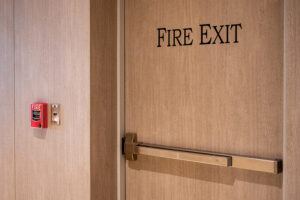
A fire door is a door that is designed to slow the spread of fire and smoke. It is typically made of materials that are resistant to fire and is often equipped with features such as automatic door closures and smoke seals. They are intended to protect the occupants of a building by compartmentalizing it and slowing the spread of fire, smoke and heat, thus providing an escape route and time for the fire department to arrive.
Propping open doors has become a common violation of fire codes after the pandemic because people didn’t want to become exposed to germs on common touchpoints. Fire doors must remain closed, although some may be designed to automatically close when fire and smoke are sensed by fire detection equipment.
Britons and fire doors
- 75% know how fire door functions
- 32% would not report problems
- 49% feel it is not their role to report problems
- 44% wouldn’t act over a propped open fire door

